

There's a Sunday brunch you have been meaning to host for three months.
Not a complicated one. Nothing elaborate. Eight people, late morning, something beautiful on the table, nowhere to be until the afternoon. You have the space. You have the guest list in your head. You have, if you are being honest, been thinking about it every Sunday morning when you wake up to an empty calendar and the specific quiet of a Washington DC weekend that has not been claimed by anything yet.
It has not happened because something in the way you think about hosting has made it feel bigger than it is. More preparation required. More coordination. More of the thing that exhausts you about hosting, the management of it, the production of it, the anxiety about whether it will be good enough, than a Sunday morning has room for.
Creating Meaningful Gatherings
- Create a welcoming atmosphere for all guests
- Plan for easy conversation and mingling
- Include options that bring people together
- Consider the comfort and flow of your space
- Focus on shared experiences over perfect details
Here's what the professional hosts who do this well have figured out that most people have not: brunch is the easiest gathering format available to a DC professional. Not the second easiest. The easiest. And the social return it produces, the specific quality of connection that a Sunday morning gathering creates, is disproportionate to the effort it requires when it is designed correctly.
The cultural case for why brunch works differently than dinner, the research on what makes it socially distinctive, and the practical framework for hosting one that people want to repeat every month until it becomes the thing your social circle builds itself around.

Why Brunch Works Differently Than Dinner
The dinner party carries weight. It implies evening, which implies a social commitment of indeterminate length. It implies a certain level of production, the right lighting, the right music, the question of whether the apartment is presentable after a full week of living in it. It implies a host who has prepared, which means a host who has spent significant cognitive and logistical energy before the first guest arrives.
None of this is bad. The dinner party, designed well, produces the deepest social connection of any gathering format. But it is not always the right tool. And for the DC professional who wants to gather more often, who understands that frequency matters more than intensity, that the recurring gathering builds the community that the occasional spectacular event never will, the dinner party is not sustainable as a weekly or even biweekly practice.
Brunch can solve this.
Brunch has a natural time boundary that dinner does not. People arrive late morning and the gravitational pull of the afternoon, the errands, the preparation for the week, the ordinary Sunday momentum, provides a soft close that requires no management from the host. Nobody stays until midnight at a brunch. Nobody needs to. The gathering has a shape that is provided by the day itself rather than by the host's logistics.
Brunch is daytime, which changes the social texture of the gathering in ways that are underappreciated. The research on circadian rhythms and social behavior shows that people are more open, more relaxed, and less socially guarded in the morning hours than in the evening. The social armor that DC professionals wear, the professional performance, the strategic self-presentation, is at its thinnest on a Sunday morning. People arrive as themselves rather than as the version of themselves they bring to evening events.
Brunch also carries a specific cultural signal in Washington DC that dinner does not. It says: I'm not performing. I'm not hosting an event. I'm having people over in the way that people who are actually friends have people over, casually, warmly, without a production. That signal is received by guests before they arrive. They come relaxed because the invitation told them they could be.

The Research Case for Morning Gathering
The social psychology of brunch gathering is not extensively studied under that name — but the conditions that define brunch map directly onto research findings about what makes social gatherings produce genuine connection rather than surface contact.
The time boundary reduces social anxiety. Research on social events consistently finds that open-ended time commitments produce higher levels of social anxiety in participants than events with a clear natural endpoint. The person who arrives at a dinner party knows they are committing to an unknown number of hours. The person who arrives at a Sunday brunch knows roughly when they will leave, and that knowledge allows them to be more present in the time they are there. They are not managing their exit. They are simply in the room.
The morning format reduces performance pressure. A study published in the Journal of Experimental Social Psychology found that social performance anxiety, the tendency to present a curated version of oneself in social situations, is significantly lower in informal, daytime social contexts than in formal evening ones. The brunch format sends the social signal that this gathering is not a performance context. That signal is received and acted upon. People are more honest, more spontaneous, and more genuinely themselves at a Sunday morning gathering than at an evening event of equivalent social stakes.
The grazing format is uniquely suited to brunch. The shared spread, a central abundance of food that guests approach, reach for, and build from, is the optimal food format for a gathering designed for unhurried, wandering conversation. Unlike a plated meal, which assigns people to seats and locks them into a specific conversational configuration for the duration, or a buffet line, which moves people through a sequence and deposits them back in their chairs, a grazing spread in the center of the room keeps people on their feet and in gentle motion for the first hour of the gathering. That motion, the reaching, the sharing, the "have you tried this", is the social engine of the brunch. It creates proximity, generates conversation, and keeps the gathering warm and alive without any programming or management from the host.
The DC Brunch Specifically
Washington DC has a specific and underexamined brunch culture that any host in this city can leverage.
Brunch in DC is not primarily about the food, though the food matters. It is about the specific social permission that the weekend morning grants, the permission to exist outside of professional identity for a few hours, to be a person rather than a professional, to gather with people you actually like in an environment that does not require you to perform your best self.
In a city where the week is consumed by professional performance, by the managing, the appearing, the strategic navigation of a city built on access and visibility, Sunday morning is the exhale. The gathering that happens in that exhale is different from the gathering that happens on a Thursday evening when the week is still in the room with everyone.
The DC professional host who claims Sunday morning as a gathering space is claiming the moment when her guests are most available, most relaxed, and most capable of being genuinely present. That timing is not accidental. It is design.

The Practical Guide: How to Host a Brunch That People Want to Repeat
The Guest List
Brunch works best at a specific size. Six to ten people is the range where the gathering has enough energy to feel social without fragmenting into separate conversations that never touch. Below six, the gathering can feel intense — the social pressure of a small group at close quarters in the morning, before the day's social lubricant has had time to work, can feel like too much. Above ten, the gathering starts to feel like an event rather than a gathering. Keep it close.
Choose the guest list with intention. The brunch is not the place for the large mixed gathering where cross-silo connection is the goal, that is better served by an evening event with more time and more social runway. The brunch is for the meaningful many, the people you want to see more regularly, the relationships you want to deepen, the group whose recurring presence in your life you are investing in. It is a maintenance gathering. A nourishment gathering. Keep it warm and keep it intentional.
The Invitation
Send it Thursday. Not two weeks out, the DC calendar fills quickly and two weeks is enough time for three competing commitments to appear. Not the day before, that signals low investment and produces uncertain attendance. Thursday gives enough notice for people to protect Sunday morning, close enough to the gathering that the week's chaos has not yet arrived to displace it.
The invitation should name the intention without making it formal. "Sunday brunch at mine, 11am, nothing fancy, just good food and people I've been wanting in the same room" is the right register. It signals warmth, it signals the gathering is deliberate, and it ends with enough social specificity, people I've been wanting in the same room, that each guest understands they were chosen rather than included.
Ask for dietary needs in the invitation itself. Not as an afterthought, as a built-in question. "Any dietary needs I should know about?" is one sentence that ensures the table accommodates everyone and removes the first-twenty-minutes social anxiety of guests quietly calculating what they can eat.
The Food
This is the decision that either consumes the host or frees them.
The host who wakes up Sunday morning and begins preparing food is already behind. They are in the kitchen when the first guests arrive. They are managing timing and temperature and presentation when they should be managing the room. They exit the morning exhausted from a gathering that was supposed to be easy.
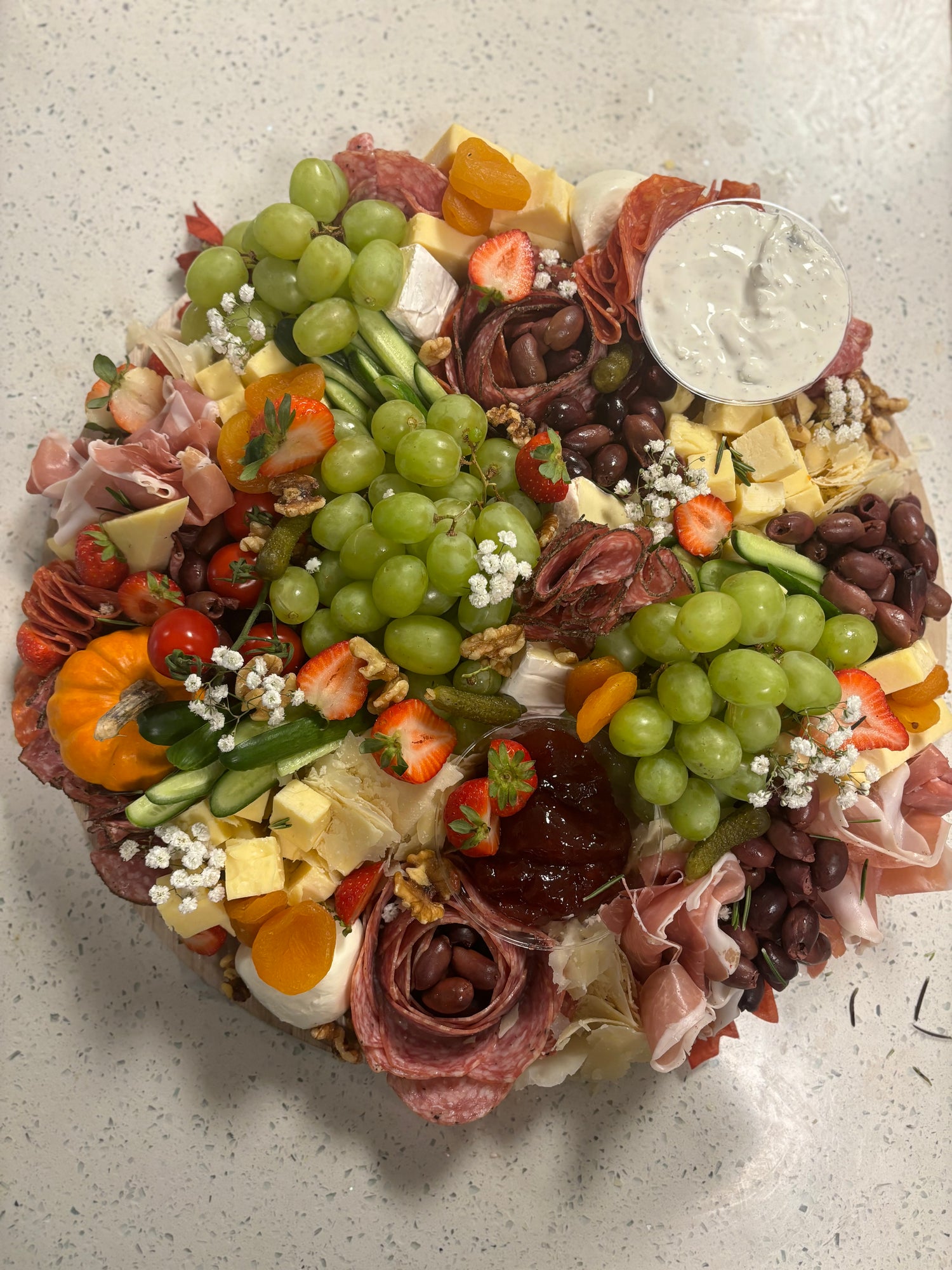
The host who has ordered a chef-curated board, delivered and ready before the first guest arrives, arranged in the center of the table, requiring no further management, wakes up Sunday and gets ready. They are at the door when the first guest knocks. They are in the room for the entire gathering. They are the host who was present rather than the host who was cooking.
The spread itself should be abundant without being overwhelming. Enough that the table looks generous, that the first thing a guest sees when they walk in is an abundance that signals care and warmth. A central grazing board with a range of flavors, textures, and dietary accommodations handles this completely. It is the social anchor of the brunch, the object guests move toward and return to, the thing that keeps the gathering warm and self-sustaining for the first hour while conversations find their footing.
Add coffee and a simple drink setup, sparkling water, juice, and one optional morning cocktail if the group calls for it, and the hosting logistics are complete. Everything else is presence.
The Room
The same principles of room architecture that apply to any gathering apply to brunch with one additional consideration: the morning light.
A brunch in a room with good natural light is a different gathering from one in a room with artificial light. If there is a choice of room, a living room with east-facing windows, a dining room that catches the morning sun, a rooftop or outdoor space, choose the one with the most natural light. Natural light is one of the environmental variables most consistently associated with elevated mood and reduced social anxiety in the research on environmental psychology. A sun-filled room on a Sunday morning is doing social work before the first guest arrives.
Beyond the light: clear a space in the center for the board. Push the coffee table to the side if needed. Create room to stand, to move, to reach. The brunch is not a seated meal for the first hour, it is a standing gathering that gradually becomes a seated one as guests settle in and conversations deepen. Design for both phases.
The Arc of the Morning
A well-hosted brunch has a natural three-act structure that the host should understand and allow rather than fight.
The first act: Arrival and orientation. The first thirty minutes are when guests arrive, orient themselves, find something to eat and drink, and begin the first conversations. The host's job here is to be at the door, to orient each arriving guest toward the center of the room, and to make one introduction within the first ten minutes of each guest's arrival. The food does the rest — the central board gives everyone somewhere to go and something to do.
The second act: The room finding its temperature. Between thirty minutes and ninety minutes in, the gathering has warmed. Conversations have deepened. People who did not know each other are finding threads. The host's job here is to watch, to read the social cues, to notice who needs a bridge, to protect the genuine conversations that are happening and not interrupt them. The food continues to anchor the room. People return to it, which keeps them in gentle motion and keeps the gathering alive.
The third act: The natural close. Somewhere around the two-hour mark, the afternoon begins to exert its gravitational pull. Guests start the quiet calculation of when to leave. This is not a failure. It is the brunch doing what brunch does, providing a soft, natural close that requires no management from the host.
The host's job in the third act is the bridge. As each guest begins their departure, the specific next step: "We're doing this again on the third Sunday. I'll text you the details." That sentence, said to each departing guest, with a specific date, is the difference between a nice morning and a recurring community.
What to Say When They Leave
The close of a brunch is quieter than the close of a dinner, less ceremonial, more gradual, as guests drift toward the door in ones and twos over the course of thirty minutes. This gradual close is one of brunch's social advantages. It allows for the individual goodbye rather than the collective one, for a specific, warm, personal exchange with each person as they leave.
Use it. Say something genuine to each departing guest, something specific to the morning, to a conversation that happened, to something you know about them. Not a generic "so glad you came", something that tells them you were paying attention. "I loved what you said about the project you're building, I want to hear how that develops." "That introduction I made between you and Marcus, I have a feeling that one is going to go somewhere." These specific closings are what guests remember. They are what makes the gathering feel like it mattered rather than merely happened.
And then, always, the date. The specific next date. Said before they are fully out the door.

The single most powerful thing a DC professional can do with the brunch format is make it recurring.
The monthly Sunday brunch, same approximate Sunday, same core group, the bar low enough that it happens even when the week has been hard, is the gathering that builds the community the dinner party aspires to but rarely achieves consistently. It is low-production enough to sustain. It is warm enough to matter. It is timed well enough, Sunday morning, when the professional armor is down and the afternoon is still available, to produce the kind of unhurried, genuine presence that connection requires.
The first brunch teaches the group that this is a good thing. The second confirms it. The third makes it expected. By the sixth, it is something people protect on their calendar, something they mention when asked what they are doing Sunday, something that has become part of how they think about their life in this city.
That is what a recurring brunch becomes. Not an event. Infrastructure. The table that is always set, the Sunday that is always claimed, the gathering that makes DC feel like a place someone chose rather than a place that is happening to them.
It starts with a Thursday text and a board in the center of the room. Everything else follows from there.
When you are ready for the board that handles the center of the room, so you can handle the room DC's most intentional brunch hosts start here. Chef-curated, hand-delivered, dietary accommodations built in. Available seven days a week with same-day delivery for orders placed before noon.

The full starter kit to hosting with intention in Washington DC, including the recurring event framework, the room architecture principles, and the complete connection deep dive, lives at here.