

Most people planning a gathering spend their preparation time on the things that feel important: the food, the guest list, the playlist, and the lighting. The thing they seldom think about is the one that shapes the social outcome of the evening more than any of those combined.
The layout of the room.
Before a single guest walks through the door, the physical arrangement of the space has already made a series of decisions on the host's behalf. It has been decided where people will congregate and where they will retreat. It has been decided whether strangers will end up in proximity to each other or whether each guest will find a corner and stay in it. It has decided whether the room will feel alive with movement and encounter or whether it will feel like a collection of separate conversations happening in parallel, never quite touching.
Most hosts do not make these decisions consciously. They make them by default, by setting up the room the way it is usually set up, by putting the food where it is convenient, by arranging the furniture the way the furniture is arranged. And then they wonder why the room felt disconnected even though the guest list was exactly right.
Essential Elements for Your Gathering
- Select a variety of textures and flavors for balance
- Include something for every dietary preference
- Add visual interest with colorful fruits and garnishes
- Provide proper serving utensils for easy sharing
- Consider the flow of your space for optimal placement
Room architecture is not interior design. It is social design. And once you understand the principles, you cannot unsee them.

The Science of Social Space
Environmental psychology, the study of how physical space shapes human behavior, has been producing consistent findings about social interaction for decades. The foundational work came from architect Christopher Alexander, whose landmark research identified what he called "patterns" in human environments that either supported or suppressed social connection. His finding, replicated across cultures and contexts, was that physical space is never neutral. Every arrangement of furniture, food, and focal points produces a specific social outcome. The question is not whether the room will shape behavior. It is whether the host will shape it deliberately or by accident.
Robert Sommer's research on personal space and social interaction added another layer. Sommer found that the distance between people is one of the most reliable predictors of whether a conversation will begin. People in what he called "sociofugal" arrangements, facing away from each other, separated by furniture, oriented toward walls or screens, are significantly less likely to initiate social contact than people in "sociopetal" arrangements, where the physical space orients them toward each other and creates natural proximity.
The implications for gathering design are direct. A room where the furniture lines the walls and the center is empty is a sociofugal arrangement. It pushes people to the perimeter and away from each other. A room with a focal point in the center, something that draws people in from multiple directions and creates natural proximity, is sociopetal. It pulls people toward each other and toward the conditions in which conversation begins.
Studies on event design have found that central food placement increases the number of new social interactions at a gathering by a significant margin compared to perimeter placement. Not because the food itself creates a connection, but because of what movement toward a central focal point does to the social geometry of a room.

The Five Decisions That Determine Who Talks to Whom
Every gathering space, a living room in Capitol Hill, a conference room on K Street, a rooftop in Navy Yard, a loft in Shaw, presents the same five design decisions. Most hosts make them unconsciously. Here is what happens when you make them deliberately.
Decision 1: Where Does the Food Go
This is the most important spatial decision in any gathering and the one most consistently gotten wrong.
Food placed against a wall, on a kitchen counter, or in a separate room from the main gathering space does three things: it creates a one-directional approach path, it deposits guests back into the main room after they have served themselves with nothing to do with their hands, and it removes the one social object that gives strangers a low-stakes reason to stand next to each other.
Food placed in the center of the room does the opposite. It creates a multi-directional approach; guests converge on it from all sides, which means they consistently end up in proximity to people they did not arrive with. It keeps people on their feet and in motion, which is the physical condition most conducive to new social contact. And it gives every person in the room a shared object of attention and a ready conversation opener.
"What is that?" "Have you tried this one?" "Is this the fig jam or the honey?" These are not profound exchanges. They are the first twenty words of every connection that ever formed at a gathering. The central table creates the conditions for them. The perimeter table eliminates those conditions almost entirely.
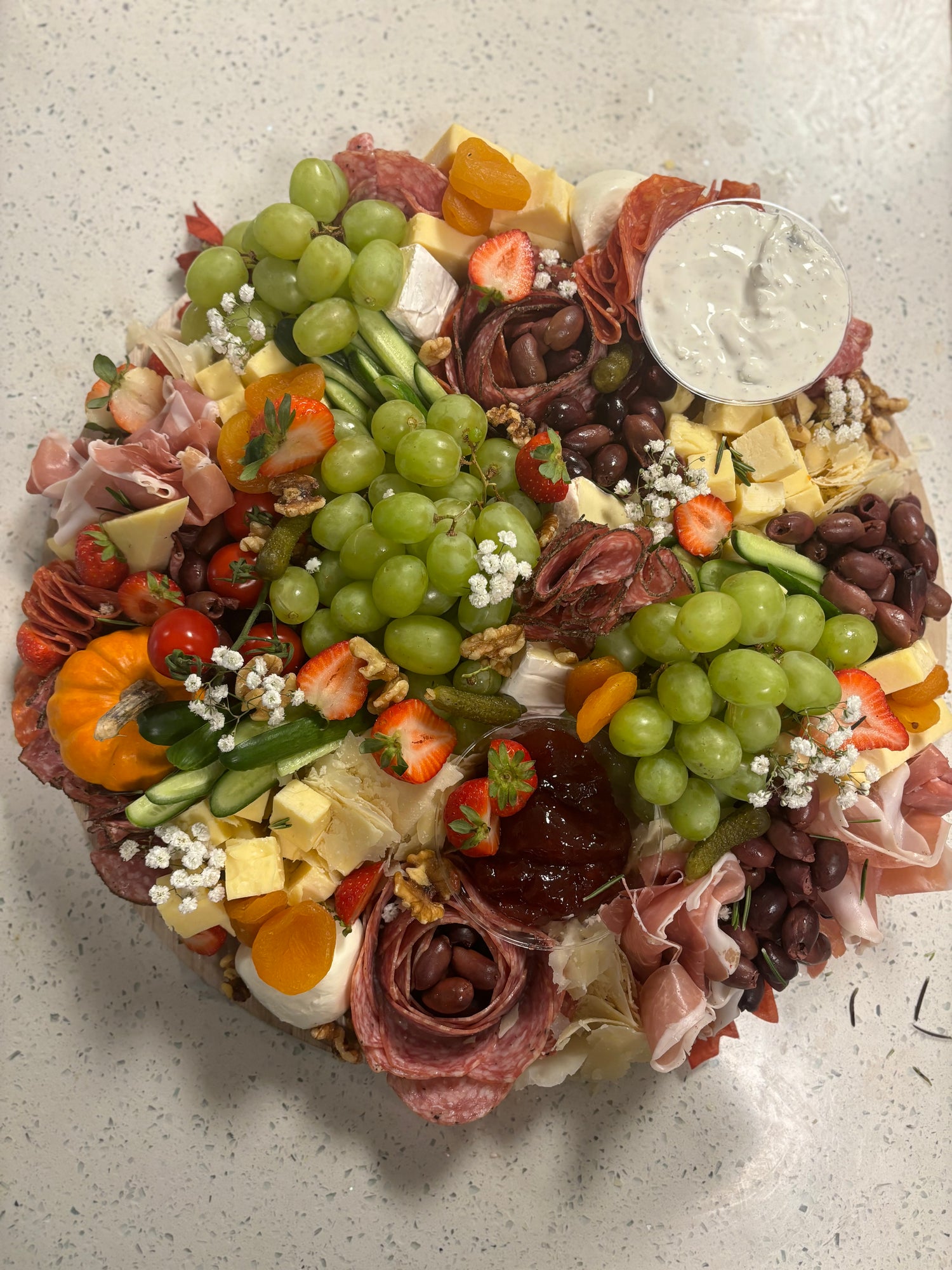
A chef-curated grazing board positioned in the center of the room does something a plated dinner or a buffet line cannot: it keeps the gathering in motion around a shared object of beauty and abundance for the entire evening. People return to it. They linger near it. They use it as an anchor and a reason to stay in the center of the room rather than retreating to the walls.
Decision 2: What Happens to the Back Wall
Every room has a back wall, the point furthest from the entrance that becomes, in the absence of any competing attraction, the default destination for guests who do not know where to go. Guests who find the back wall early in a gathering tend to stay there. They have oriented themselves, established a territory, and the social cost of moving — of approaching a conversation already in progress, of navigating toward someone they do not know, has now become higher than the social benefit of staying put.
The fix is not to tell guests to move. It is to remove the option.
Push furniture away from the back walls before the gathering begins. Place something interesting, the food, a drink station, a conversation piece, anything that requires approach, at the point where the back wall would otherwise invite retreat. Make engagement the only option. A guest who arrives and finds that there is no comfortable back wall to disappear against will orient themselves toward the center of the room by default. Which is exactly where you want them.

Decision 3: Standing or Seated
This decision should be made based on the social goal of the gathering, not on convention or convenience.
For gatherings where the goal is new connections, corporate events, mixed-group parties, community gatherings, any event where guests do not already know each other well, standing height tables or a standing room with a central focal point produce significantly more social interaction than a seated arrangement. When people are standing they move freely. Conversations are shorter, more numerous, and more likely to cross the lines of existing social groups. The social cost of approaching someone new is lower because the physical commitment of joining a conversation is lower. You can step into a conversation standing at a grazing table and step out of it without the social weight of leaving a seated dinner.
For gatherings where the goal is depth, the intimate dinner for six, the recurring monthly gathering, the evening designed for a specific group to go somewhere real together, a seated arrangement is the right choice. It creates the social commitment that depth requires. It keeps people in proximity long enough for conversations to develop past the surface. It signals that this gathering is designed for staying, not circulating.
Most hosts default to one format regardless of their social goal. The intentional host matches the format to the intention.
Decision 4: The Arrival Experience
The first five minutes after a guest arrives are the most socially consequential of the entire evening. A guest who enters a room and immediately has something to orient toward, a host who is present and welcoming, something to hold, and a clear path toward the center of the room relaxes into the gathering. A guest who enters to find their host in the kitchen, no one at the door, and a room full of conversations already in progress is on the social back foot from the moment they arrive. They will spend the first twenty minutes of the gathering recovering from that initial disorientation.
The practical design implications are simple. Know where you will be when the first guests arrive, and be there, not in the kitchen making final preparations. Have something for them to hold within thirty seconds of walking in. A drink, a small plate, anything that gives their hands something to do, and reduces the exposed feeling of arriving somewhere new. And have somewhere clear for them to go, ideally toward the center of the room, toward the food, toward another guest you are about to introduce them to.
The arrival experience is a design problem. It has a design solution.
Decision 5: The Margin
This is the decision that feels most counterintuitive and matters more than most hosts expect.
Leave space. Physical space between the dishes on the table. Time between the activities on the agenda, if there is one. Breathing room in the layout of the room itself, space to move, to migrate, to change conversations without navigating through a crowd.
The gatherings that feel effortless feel that way because the host built margin into every dimension of the experience. Overcrowding, of food, of furniture, of programming, creates a social pressure that guests unconsciously register and unconsciously resist. They feel hemmed in. Conversations become shorter because there is no room for them to breathe. People leave earlier because the physical environment has been subtly stressful all evening.
White space in a room is not emptiness. It is an invitation. It is the physical signal that there is room for something unexpected to happen, for a conversation to wander, for two people to find a quiet corner, for the gathering to develop its own momentum rather than being managed into a predetermined shape.

What This Looks Like in Practice
A Capitol Hill rowhouse with a living room that seats eight around a central coffee table, a kitchen counter pushed against the back wall, and furniture lining the perimeter is a sociofugal arrangement by default. Guests will cluster in the kitchen, line the walls of the living room, and the center of the space will sit largely empty all evening.
The same rowhouse with the coffee table pushed to the side, a grazing board positioned in the center of the cleared living room floor on a low table or board stand, drinks accessible from two directions, and the kitchen counter cleared and closed off is a sociopetal arrangement. Guests will converge on the center. They will move. They will end up next to people they did not arrive with. The room will feel alive in a way the first arrangement never will, with the same guest list, the same food, and the same host.
The difference is not the apartment. It is the architecture.
The same principles apply at scale: a K Street conference room rearranged to put a central grazing installation in the middle of the floor instead of along the back wall, with high tops placed asymmetrically to prevent clustering, will produce a different quality of social interaction than the same room set up in the default configuration. The space is the same. The social outcome is not.
The One Change That Changes Everything
If there is a single design decision that produces the most consistent improvement in the social quality of a gathering, it is this: move the food to the center of the room.
Not to a more convenient location. Not to a spot that makes serving easier. To the center. To the point that requires guests to move toward it from all directions, to stand near it and near each other, to reach for it, and in doing so to reach, slightly, toward the people standing beside them.
Everything else in this post is refinement. That one decision is a transformation.
The complete room setup guide, including a spatial checklist for any gathering space, a diagram-based setup tool, and the arrival experience framework is inside the Wedge-In Connection Starter Kit.

When you are ready for the thing that goes in the center of the room, the board that changes the social geometry of your gathering and gives your guests somewhere beautiful to gather around: DC's most intentional hosts start here.