

What you will take away:
1. The dinner party is a correction, not a trend.
2. Loneliness data makes gathering urgent now.
3. Four to six people is the optimal size.
4. DC needs community, not more access.
5. Shared food is the fastest path to trust.
6. Outsource the food. Handle the room.
7. One prepared introduction changes everything.

Keep reading for the full DC context, and the practical guide to hosting a gathering people actually want to repeat

Something is happening in Washington DC.
Not on the Hill nor in headlines. In the apartments and rowhouses and converted lofts of a city that has spent the better part of a decade outsourcing its social life to restaurants, rooftops, and reservation apps. People are cooking again. Or rather, people are gathering again. Around tables. In living rooms. With six people and a spread in the center, and nowhere to be until the conversation runs out.
The dinner party is back, like it never left.
Not the formal dinner party of a previous generation, the one with the china pattern and the seating cards and the ambient pressure to perform for people you see twice a year. That version was always more production than connection, more event than gathering. What is coming back is something older and simpler and considerably more powerful. A small group of people. A shared table. An evening with no agenda except being in the same room together.
In a city drowning in loneliness and division, the return of the dinner party is not a trend. It's the course correction.

What Happened to the Dinner Party
To understand why it is coming back, it helps to understand where it went.
The dinner party declined gradually and then all at once. Gradually, through the 2000s and 2010s as restaurant culture expanded, as the logistics of gathering at home began to feel laborious compared to booking a table, as the social performance anxiety of hosting- the right food, the right apartment, the right impression- made the whole enterprise feel like more trouble than it was worth.
Then all at once, for reasons that do not need to be named, the restaurant option disappeared entirely for a period, and something unexpected happened. People remembered how to have each other over. They remembered what a kitchen table actually felt like when the right people were around it. They remembered, with some surprise, that the gathering they were hungrier for was not the curated restaurant experience. It was the unscripted one.
The pandemic did not create the dinner party's return. It accelerated a recognition that was already forming underneath the surface of a social life that had been getting progressively more outsourced, more optimized, and more hollow for years.
Sociologist Robert Putnam identified this hollowing out decades ago. His research on social capital documented the systematic decline of recurring social rituals — the standing gathering, the neighborhood dinner, the community table — as the single most significant driver of community erosion in American life. Not the absence of desire for connection. Not a decline in social skills. The disappearance of the structure that gave connection somewhere to happen consistently and for free.
The dinner party is that structure. And its return is not coincidental.

Why Now Specifically
The timing of the dinner party's return is not random. It is a response to a specific set of conditions that have converged in the mid-2020s and made the small, intentional gathering feel not just appealing but necessary.
The loneliness data is the first condition. The U.S. Surgeon General's 2023 advisory on social connection named loneliness a public health crisis. The American Psychiatric Association found that 1 in 3 American adults feel lonely every week. AARP's 2025 research found that 4 in 10 adults over 45 are lonely, a record high. These numbers describe the people at dinner parties as much as they describe anyone else. The person who hosts a gathering on a Thursday evening is responding to something real in their own life and in the lives of the people they are calling together.

The disillusionment with digital connection is the second condition. A decade of social media promised connection at scale and delivered visibility at scale, which is a different thing entirely. The research on social media and loneliness is consistent: more platform engagement correlates with more loneliness, not less. The person who has spent years building a digital network and still feels profoundly disconnected is the person most likely to reach for something analog. Something embodied. Something that requires physical presence and produces the specific physiological experience of being genuinely in a room with people who know them.
The third condition is specific to Washington DC. This city is in a period of unusual social flux. Political transitions, institutional reshuffling, the constant churn of people arriving and departing, and the social infrastructure that holds DC together are under more strain than usual. The people who navigate this city's transience most successfully are the ones who build their own social infrastructure rather than relying on the city's professional networks to provide it. The dinner party is how they do it. It is how it has always been done here, in the Georgetown drawing rooms and the Capitol Hill rowhouses and the Adams Morgan apartments where DC's most connected people have always gathered, not at events, but at tables.

What the Research Says About Why It Works
The dinner party's return is not just a cultural preference. It is a response to a body of evidence about what actually produces human connection and what does not.
Oxford evolutionary psychologist Robin Dunbar's research on social bonding identified shared meals as one of the most reliably effective connection mechanisms in human social life, more effective than conversation alone, more effective than shared activities, more effective than the professional networking event that DC has spent decades treating as a social substitute. The communal act of eating together triggers endorphin release through the same neural pathways activated by physical touch. It creates a physiological state of reduced threat perception and increased openness that is the prerequisite for genuine exchange.

The size of the dinner party matters more than most people realize. Dunbar's research on group dynamics found that four to six people is the optimal gathering size for genuine social bonding. Below four, the social pressure of a small group can feel intense. Above eight, conversations fragment and the gathering starts behaving like a party, high energy, low depth. Four to six people around a shared table is the specific configuration in which the kind of conversation happens that people reference months later. Not because something dramatic was said. Because something real was.
The research on relationship formation adds another layer. A 2018 study in the Journal of Social and Personal Relationships found that it takes approximately 50 hours of shared time to move from acquaintance to genuine friend and approximately 200 hours to develop a close friendship. These hours cannot be compressed. They accumulate across repeated, ordinary interactions, across the twelve monthly dinners that compound into a shared history that is worth more, in terms of social resilience and genuine belonging, than any number of spectacular one-off experiences.
The dinner party, done monthly, does this work automatically? It is a compounding investment in the relationships that matter most, disguised as an evening with good food and nowhere to be.

Why Washington DC, Specifically Needs This Right Now
Every city has its version of the loneliness problem. Washington DC has a version that is specific to its character and worth naming directly.
DC is a city that makes professional connections easy and personal connections structurally difficult. The professional identity is too consuming. The pace is too unrelenting. The transience is too constant. People arrive here with ambition and leave when the chapter closes, and the social circles built around professional context dissolve with the professional context that produced them.

The DC professional who has been here for five years and has a full calendar and a thriving LinkedIn network and still feels like something essential is missing in their social life is not imagining things. They have built the wrong kind of connection for the wrong kind of belonging. A professional connection provides access. Personal connection provides roots. And roots, in a city that is always threatening to pull them up, are what make it possible to stay here without being slowly consumed by it.
The dinner party builds roots. Not in one evening. Across many of them, with the same people, until the gathering becomes the constant and the community forms around it. The person who hosts a recurring dinner in Washington, DC, who sends the text on Thursday, puts something beautiful in the center of the table, and makes an introduction that would not otherwise have happened, is doing something that matters beyond the evening itself. They are building the social infrastructure that DC does not provide and that no professional network can substitute for.
They are also, according to the research, extending their own life. The mortality data on social connection are among the most robust in public health. People with strong social relationships live longer. The specific mechanism- reduced cortisol, improved immune function, better cardiovascular outcomes- is well understood. The dinner party is not a treat. It is a healthy behavior. The CDC classifies it as one.

What the Return Actually Looks Like
The dinner party that is coming back does not look like the one that declined.
It is not formal. Nobody is using the good china unless the good china makes them happy. It is not catered to a professional audience, not a networking event with a dining room attached, not an opportunity to be seen by the right people. It is genuinely social in a way that DC's professional culture has made almost radical: a small group of people gathered around a table with no agenda except being there.
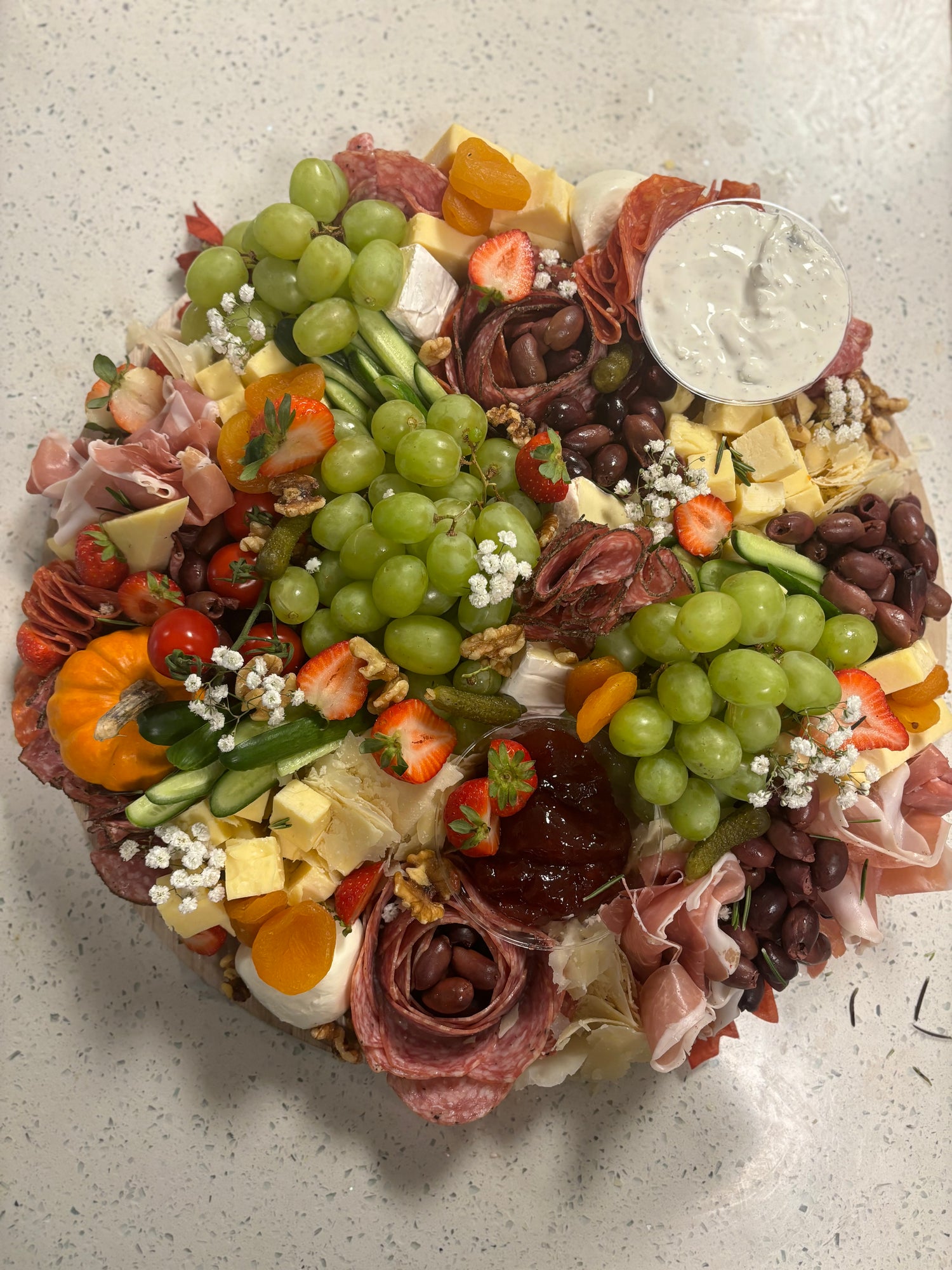
The food has changed too. The dinner party that exhausted a previous generation of hosts required hours of preparation that consumed the host before the first guest arrived and left them depleted before the evening began. The version coming back is smarter about this. The host who orders a chef-curated grazing board — delivered, arranged, in the center of the table before anyone arrives — has removed the one variable that historically made hosting feel like work. The food handles itself. The host handles the room. The evening handles itself from there.
The host who is present in the room, who is at the door when guests arrive, who makes the introduction in the first ten minutes, who watches the room and responds to what they see, is doing the work that actually produces connection. The food was never the work. The presence was always the work. Outsourcing the former is what makes the latter possible.

How to Start
The dinner party that matters does not require a special occasion. It does not require a perfect apartment or a perfectly curated guest list or a host who has their social life fully assembled. It requires a date, a group of four to six people, and something beautiful in the center of the table.
Here is the only thing worth getting right before the first gathering: the introduction. Before the guests arrive, identify two people in the room who do not know each other but should. Prepare one specific, interesting detail about each of them and one sentence that connects them. Make that introduction within the first ten minutes. Then step back and let the evening develop from there.
That introduction, the specific one, the prepared one, the one that puts two people in proximity with a genuine reason to talk, is the single act that separates the dinner party that produces connection from the dinner party that produces a pleasant evening. It is fifteen seconds of effort that can change the social trajectory of the room and, occasionally, the trajectory of the people in it.
The research, the data, the cultural moment, all of it points in the same direction. The table is where connection happens. The dinner party is how the table gets set. And in a city that is hungrier for genuine community than it has been in a generation, setting it is one of the most useful things a person can do on a Thursday evening.

The full framework for building the gathering that compounds over time, the recurring dinner, the room architecture, the introduction template, the social cues, lives at the convergence of connection.
And when you are ready for the board that handles the center of the table so you can handle the room, DC's most intentional hosts start here.